From Cwmavon to California • Richard Perkins

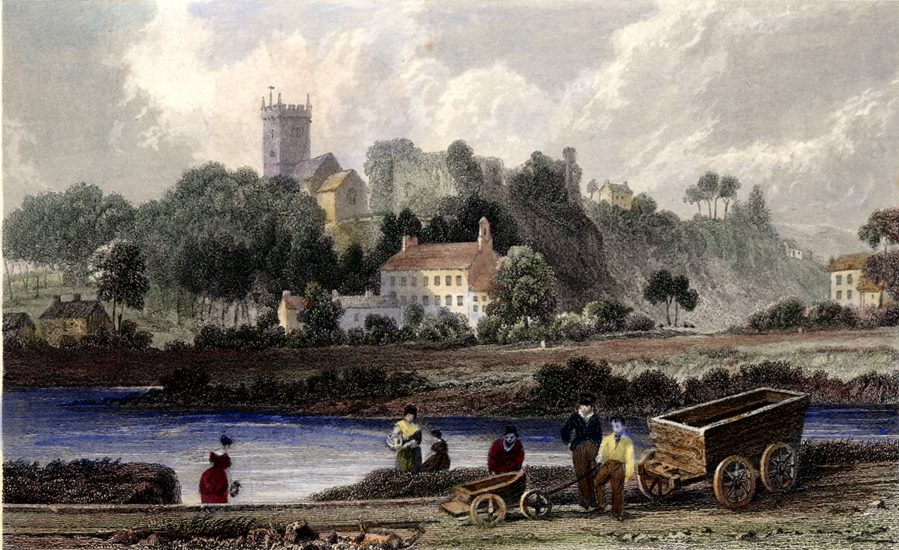
A view of Cwmavon.

In this blogpost I will be sharing the story of my Uncle Richard Perkins. 

Those who have followed my work for a while will know that while I was researching my late father's family tree, I came across a family connection to Glamorgan County Lunatic Asylum. My great-great-great-great-uncle Richard Perkins died at Glamorgan County Lunatic Asylum in 1898. 

For Mental Health Awareness Week, I wanted to share his story with you. 

Although not much is known about his early life, I have been able to trace him through newspaper articles, casefiles, census records and burial records. 

A view of Cwmavon

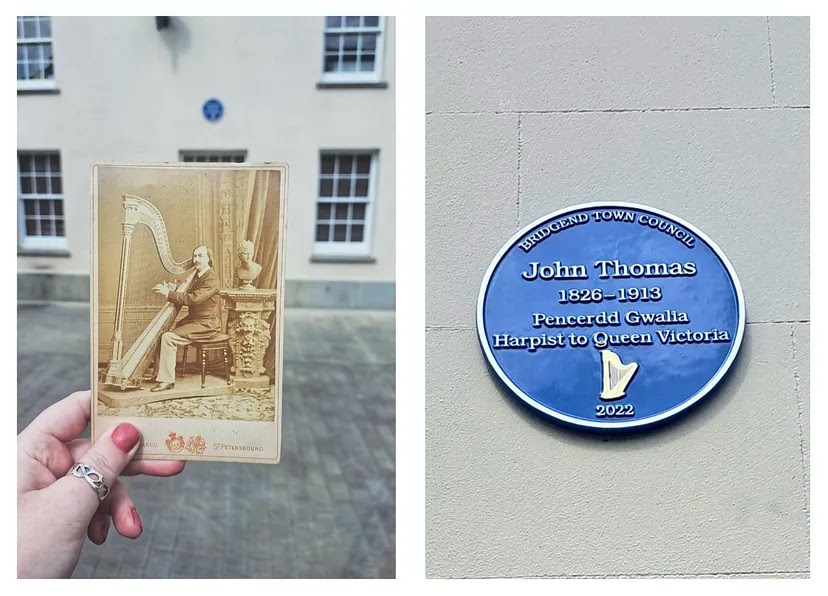
John Thomas, Royal Harpist • 1826–1913.

The Blue Place at the street John Thomas was born in. 

Last month, a Blue Plaque commemorating the life of the Royal Harpist, John Thomas, was unveiled in his hometown of Bridgend. Having worked on this with Bridgend Town Council, to accompany the event, I wanted to write something short about John and his life.

The quotes in this article (unless specified) are taken from John’s own biographical notes written in the 1880s. A few weeks ago, I was given the opportunity to see his personal papers at the National Library of Wales.

In his own words: “I was born at Bridgend, Glamorganshire, South Wales on St David’s Day 1826 and am the eldest of a musical family.”

Born on St David’s Day, 1826, John Thomas was the eldest of seven children born to John Thomas, a tailor, and his wife Catherine Jones of Elder Lane.

"If at any time, at any place, and under any circumstances, you can do a good turn to a fellow Bridgendian, remember that it is a privilege to do so." | John Rankin B.A.

John Rankin B.A.


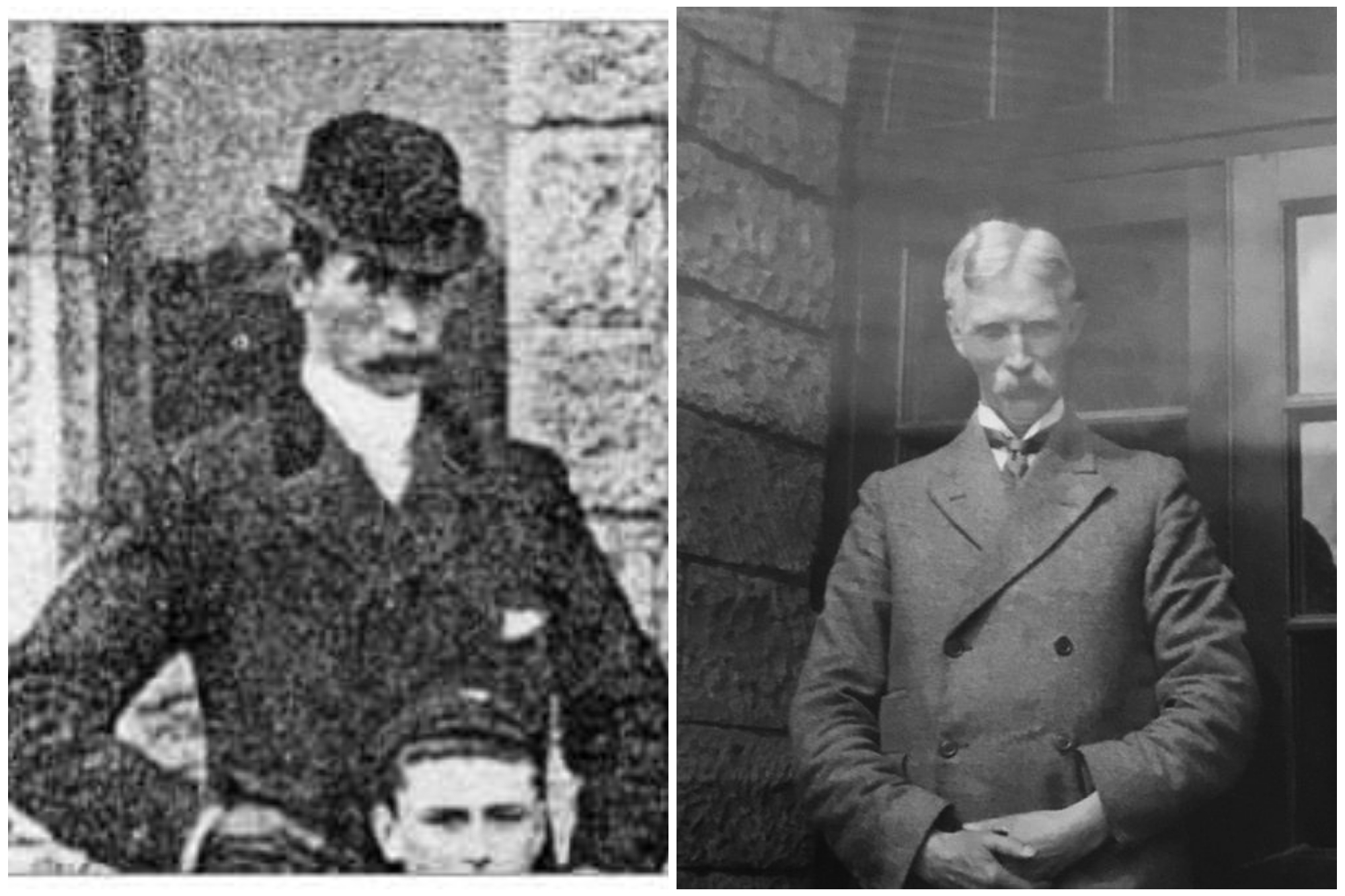
For those who attended Bridgend County School, Heol Gam or Brynteg Comprehensive School, John Rankin B.A. will be a familiar name. 

The first headmaster of Bridgend Intermediate School (later Brynteg) John served the community of Glamorgan as a teacher and educator for 43 years. But, who was John Rankin B.A?  In this blogpost, I take a look at the life of an Irish man who became a key figure in many children's lives. 

Unfortunately, not much is known about the early life of John.  What little we know has been drawn from census records, certificates and newspaper articles. 

John Rankin was born on the 21st of  August, 1863. He was the eldest of nine children born to James and Elizabeth Rankin of  Castleblaney, Co Monaghan in Northern Ireland. 

John came from a deeply religious family. He was a great-grandson of Rev James Rankin, the Minister of the Presbyterian Congregation in Monaghan. It was through the Presbyterian Church that the Rankin children were able to read and write.

"Nothing short of locks or bolts could keep out the lifters." • Welsh Easter Customs.


"I recall the inhabitants of Llangollen, Denbighshire, ascending Dinas Bran on Easter Day to greet the rising of the sun with three somersaults." 

An account of Easter Sunrise from Rev. John Williams of Glanmor.


When Welsh folk customs are mentioned, we automatically conjure up images of the Wren, the Mari Lwyd and Old New Year. We don't seem to talk about what the Welsh did during the Easter period. 

In this blogpost I take a look at traditional Welsh Easter folk customs. 

 
Dydd Sul y Blodau at Ogmore Vale.

Dydd Sul y Blodau and Easter Sunday were (and still are) the days that the Welsh tend the graves of their loved ones. 

An account of the tending of graves in the Vale of Glamorgan from Charles Redwood:

“The sides of the graves were raised up with fresh turf and fresh earth was placed on the surface; the end stones were whitewashed and women planted rosemary and rue whilst girls brought baskets of crocuses, daffodils and primroses which they placed in somewhat fantastic figures upon all graves.”

In rural parts of Wales, particularly north Wales, no elaborate flowers were placed on graves on these days. Instead, people chose to clean the graves of their loved ones. The graves were whitewashed, weeds were pulled and simple tributes were left by loved ones. 

"So help me God she won't come down for me again in a hurry." • The Bridgend Murder


On the night of the 12th of August 1872, Selina Jones was found dead in her home at 34 Newcastle Street. Later known locally as “The Bridgend Murder” - It was initially suspected that her death was caused by a series of falls she had earlier that evening but over the days that followed something very different was uncovered.

Unfortunately, not much is known about the early life of both Thomas and Selina Jones. What little we know has been drawn from census records, court records, and newspaper articles. 


A newspaper article reporting the trial of Thomas and Selina. 


The first record of Thomas Jones and Selina Adams (Adams was Selina’s maiden name) in Bridgend can be found in the Glamorgan Calendar of Prisoners for the year 1857. 

In Loving Memory • Death Collections at the National Museum of Wales.


Portrait of Mrs William Williams of Caernarfon. It shows her wearing a mourning dress, and a brooch with an image of a man - possibly her husband, Captain Williams. 


The National Museum of Wales is home to a collection of over half a million objects relating to Welsh life, history and culture. In these collections, you will find everything from taxidermy animals to bracelets made of human hair.

Of course, the collection includes an array of objects related to death and mourning – my specialist subject! In this blogpost, I will be sharing a few of my favourite objects and their stories. 

A horse skull draped with ribbons | The Mari Lwyd


The Mari Lwyd at St Fagans 2019.

The Mari Lwyd is perhaps one of Wales' most well-known folk customs. A horse skull draped with ribbons, the Mari Lwyd (The Grey Mare) often startles those who meet her for the first time. 

She usually makes her appearance between December and Old New Year, with the longest continuous Mari Lwyd taking place every year in the sleepy village of Llangynwyd in South Wales. 

Finding Alice Edwards.

In affectionate memory of 

Alice,

The dearly beloved daughter of Charles & Martha Edwards, of The Bush, 

Died October 19th, 

Aged 13.

Interred at Evancoed Church, October 22nd, 1881.


A while ago I purchased a bundle of mourning cards from Nolton Antiques in Bridgend. While looking through my bundle of mourning cards I found the mourning card for a young girl called Alice. I decided that I wanted to 'find' Alice.

What is a mourning card? 

Mourning cards were often given out to friends and relatives as keepsakes at funerals. The predecessor of what we now know as an 'order of service', these cards were usually decorated with a black border, a verse, and an illustration. On occasion, a photograph of the deceased would be included on the card. 


A Perfect Nuisance | Donald Mortimer Warner.

A view of Glamorgan County Lunatic Asylum (Angelton)


In this blogpost, I write about Donald Mortimer Warner. 

When I read Donald's case-file, I found myself wanting to know how and why this young man ended up so far from home. I wanted to know where he came from, who his family were and how he became ill. 

Although not much is known about his early life, I have been able to piece this gentlemans life together through newpaper articles, census records and casefiles. 

Content warning: The newspaper articles and transcribed of case notes in this blogpost contain racist language. 

"a widespread manifestation of public sympathy and sorrow" | Nurse Hannah Dunlop Mark

The CWGC War Grave of Nurse Hannah Dunlop Mark.


While researching those who died during the First World War, I came across a local woman who was buried in Bridgend Cemetery.  Nurse Hannah Dunlop Mark of the Territorial Nursing Force died on the 10th of October 1918. 

On her death, Hannah was described as "an ideal nurse, kind and gentle in her ways and extremely popular with her colleagues...” But who was she?

An Overdose and Heart Failure | The Deaths of Mrs Yellowlees & Mrs Pringle.

A view of Angelton Asylum. 


In this blogpost, I explore the lives of two women; Margaret and Jessie. Known simply as Mrs Yellowlees and Mrs Pringle, they were the first wives of Dr David Yellowlees and Dr Henry Turnbull Pringle of Angelton Asylum. 

On the surface, it would seem that the only connection they have is that they were both 'just' doctors wives. Although they died 27 years apart there is a much deeper connection between them. Margaret and Jessie both lived in the same house, walked the same corridors, ate with the same dinner guests and both tragically died young. 

Unfortunately, but unsurprisingly, the lives of Margaret and Jessie have not been documented in great detail. The following information has been drawn together from various certificates, newspaper articles, and archive material. 

The Lonely Soldier | Charles William Murphy

The headstone of Pte. Charles William Murphy.


Those of you who live locally will know the story of the 'lonely soldier' buried in a 'field' behind Glanrhyd Hospital. People say that he died of shell-shock, others say that he was abandoned by his family and that he is buried on his own.

The Stench is Unbearable | Clark's Inspection of Bridgend.

A view of Bridgend. 

On the 4th of June 1849, two petitions were sent to the General Board of Health on behalf of the inhabitants of the hamlets of lower Coity and lower Newcastle – what we now know as Bridgend Town Centre. These petitions requested advice and instructions on to deal with the dangerous sanitary conditions of the town and the growing fear of Cholera.

As a result of these petitions, George T Clark of Talygarn was commissioned to carry out an inquiry into the sanitary conditions of Bridgend. This inquiry took place between the 8th and 11th of August 1849.

'My dearest Sarah' | A Bridgend Love Letter.


Detail of the letter. 

While going through the National Museum of Wales Collections, I came across a love-letter. Addressed to a 'Miss Sarah Al..' of the 'Glove and Shears, Bridgend', it is posted marked 14th of February 1845. It contains beautiful handwritten pieces of poetry.


"Excuse me, dear, for being so bold,
As not write your name in gold, 
the gold was scarce as you may think,
that made me write your name with ink."

Useful, harmless, and demented | Arthur Henry Banner

A postcard of Angelton Asylum, Bridgend.


Those who follow my work will know that I am currently researching and writing about the patients of Glamorgan County Lunatic Asylum. This is my second blogpost about a patient of Angelton Asylum, the first post being about Thomas 'King' Rees. It is interesting to note that the gentleman I am writing about in this post would have known Thomas.

In this post, I write about Arthur Henry Banner. 

Arthur was the son of one of the first members of the rural police force at Newbridge. He was a husband, a father and a grocer. He was one of the few who were not buried in the Angelton Asylum Cemetery. His family paid for his body to be removed from the asylum and to be buried with his family.


Glamorgan History Society | Writing for the Morgannwg Journal

Morgannwg Journal - 1957.


In late 2018 I was approached by Lisa Tallis, the Assistant Librarian at Special Collections and Archives at Cardiff University and co-editor of the Morgannwg Journal to write a piece for their new section on online and digital resources. As someone who regularly uses the journal as a research source, I jumped at the chance to write for the journal.  

What is the Morgannwg Journal?

The Morgannwg is the journal of the Glamorgan History Society. Founded in 1950, the Society promotes an encourages the study of the history of the county of Glamorgan. The Society published the first volume of its journal 'Morgannwg' in 1957. The bi-lingual publication was funded by Society subscribers and a donation from the Welsh Church Act Fund of Glamorgan County Council.

Demented, happy, and useful | Who is Buried Here? - Thomas 'King' Rees

A view of the original Angelton Asylum Cemetery.


Following my posts about Dr Robert Sloss Stewart, Eleanor Davidson and Francis Hill, I have continued my research into the lives of the other seven gravestones that remain in the original Angelton Asylum Cemetery. Due to the amount of information, I have decided to share my research via a series of posts.

In this post, I will be writing about Thomas 'King' Rees. 

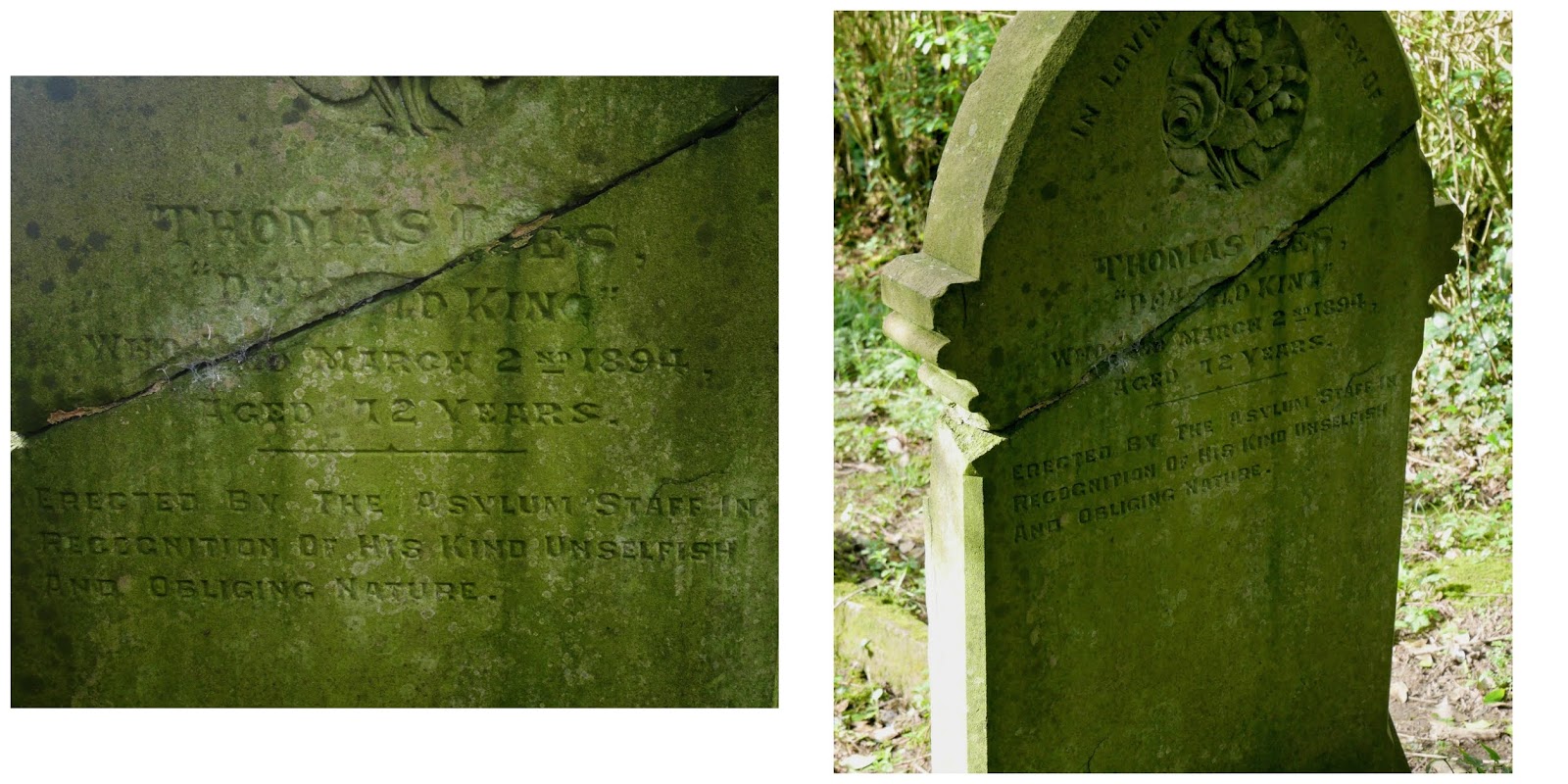
Out of the hundreds of men, women and children buried in the original Angelton Asylum Cemetery Thomas 'King' Rees is the only patient who has a gravestone. He is buried in the location where the staff of the asylum and their relatives are buried. It is clear that Thomas was a highly respected patient as his gravestone was paid for by the staff of Angelton Asylum. 

"Erected by the Asylum Staff in Recognition of his kind unselfish and obliging nature."

The gravestone of Thomas Rees. 


Sin-eating & Singing | A Welsh Funeral.

A funeral at Llansteffan - Peoples Collection Wales


From Ty Corff to Sin-eating, I'll be exploring death, burial and mourning customs/ traditions relating to Wales. Although some of these will seem alien to us, these customs were an important part of the death and funeral process.

Ty Corff, Gwlynos, and the Funeral 

In rural Wales, the death of a local person was formally announced by the bell of the parish church.

During the hours following the death, the 'Diweddu' took place at 'Ty Corff'. This was the washing and preparing of the body before it was placed in the coffin.

When the body was placed in the coffin, certain steps were taken that were thought to prevent decay and the influence of evil. A pewter plate filled with salt was placed on the chest of the deceased. In Betws-y-coed, a piece of green sod, wrapped in paper was used instead of salt. By this time, the coffin would have been moved into the family home. Members of the deceased family and neighbours volunteered to sit up each night in the room in which the body rested. This was known as 'Gwylio'r Corff.'

"People of the Poorest and Dirtiest Class." | Caepantywyll.

Girl in a graveyard, Bruce Davidson - 1965.


Many of you will recognise this photograph taken by American photographer Bruce Davidson in 1965. Part of the 'Welsh Miners' series, it is one of many taken during his tour of the South Wales Coalfield with poet Horace Jones. Images from Davidson's 'Welsh Miner' series can be found here.

A few months ago, while on Twitter, I came across a thread of photographers keen to discover where the above photograph was taken. I suggested researching the names of the headstone that the young girl is stood next to. Those names were 'Sarah' and 'Roger Christopher.'

From the information on the headstone, I managed to trace the location of the burial ground to Capel Bethlehem, Caepantywyll.

Unfortunately, not much is known about Caepantywyll. What little we know has been drawn from census records, sanitary reports, and newspaper articles. I've decided to focus on the period when those named on the headstone were in their prime. 

Y Gwyliau | A Welsh Christmas.

Geese at Cowbridge via People's Collection Wales


From The Plygain to the Mari Lwyd, I'll be exploring some of the weird and wonderful customs/traditions our ancestors took part in during Christmastide. Although a majority of these customs are now obsolete, it is always interesting to look back on how Christmas once was. 

"During the Victorian period, Christmas changed gradually from an intensely social occasion in which all the community took part to one of family celebration in the seclusion of private houses."
Professional Blog Designs by pipdig